
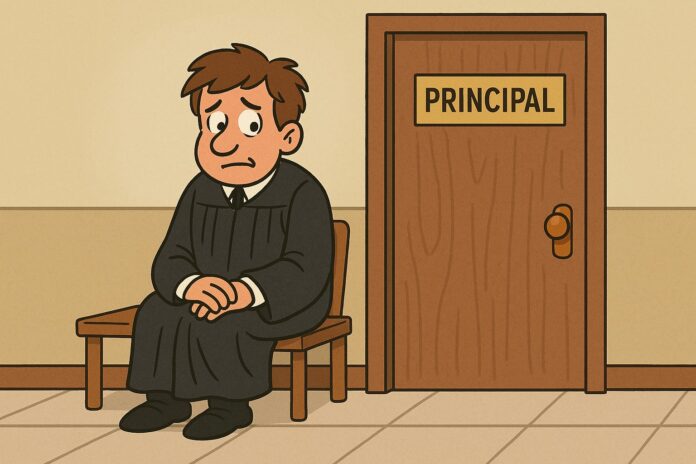
No sanction for the judge who lashed out during sentencing
A National Judicial Council review panel decided not to discipline Justice François Huot, who gave a convicted murderer this piece of his mind before sentencing:
I would have been surprised if you had apologized because, in my assessment, you are spineless, cowardly, craven. You have spent 22 years of your life living free and waking up every morning as if nothing had happened. How were you able to look at yourself in the mirror every morning while Guylaine lay six feet underground because of your moral, your sexual depravity and your killer instinct?
Eight thousand two hundred and two (8202) days of unjustified freedom between your crime and your arrest by officers of the Sûreté du Québec. How did you live, Grenon? How could you dare look at her family? How do you dare look at me? I feel only disgust and contempt for your actions on April 28, 2000. You are completely devoid of morality, you are sexually depraved, a murderer, you make me sick.
According to the review panel, the comments were improper but judges are human too.
The Ethical Principles for Judges represent an ideal, offering advice rather than prescribing a code of conduct. After all, judges are human and subject to the same emotional reactions as anyone else, particularly in difficult circumstances.
[I]t is important to recognize that emotions can run high in the courtroom and that judges must retain some degree of freedom to express themselves without being held to an impossible standard of weighing every word.
Private sanction for the judge who lashed out at the younger generation
A different review panel took a slightly harsher approach to Justice Earl Wilson’s conduct. His mistake was adopting a condescending and belittling tone, directing harsh comments at the complainant in a restraining order proceeding:
I can’t get over your generation.
You must have more time on your hands than the rest of us do.
Do something creative, work, read, study something, make something of yourself.
The review panel decided on a “private” resolution, to remind Justice Wilson about the importance of civil communication.
Reprimand for Justice Bégin
You might remember Justice Alain Bégin from the harsh words the Nova Scotia Court of Appeal used when reviewing his conduct:
- “The astonishing behaviour of the trial judge in this case requires a salutary reminder of the duty of all judges privileged to hear and decide cases in court” (R. v. K.J.M.J., 2023 NSCA 84). A case where Justice Bégin called an accused a sexual deviant before the trial was finished, then tried to purge his comments from the court record.
- “This is a reasonable apprehension of bias case unlike any other” (R. v. Nevin, 2024 NSCA 64). A case where Justice Bégin was so offended by a recusal application that he called his own character witness.
Despite the strongly worded Court of Appeal decisions, a majority of the review committee for Nova Scotia’s Provincial Court judges decided not to send the complaint against Justice Bégin to a full hearing. They based their decision on:
- Judge Bégin acknowledging his conduct and showing remorse
- Strong support from Justice Bégin’s colleagues, including his Chief Justice
- The fact that Justice Bégin has been back to work for several months without any issues
- And the revelation that Justice Bégin was suffering from an undiagnosed mental health disorder at the time of his misconduct.
Instead of a full hearing, Justice Bégin agreed to a resolution that includes a reprimand and ongoing treatment.
One member of the review committee penned a strong dissent, saying that a case of this magnitude deserves a full hearing:
[T]he conduct rises to a level which could render the judge incapable of performing the duties of his office on the basis that allowing him to continue in his role would undermine the confidence of the reasonable, dispassionate, and informed public in the justice system. The complaints should be referred to a Hearing Panel to determine whether such a serious sanction is necessary.
Paras 42 and 53, per Melanie Petrunia
[I]t would be more appropriate for a Hearing Panel to determine whether or not Judge Bégin’s medical condition mitigates his conduct. This would require a more rigorous examination of the medical evidence, including the relationship between his medical condition and the specific conduct at issue, and a proper consideration of the intersection between judicial wellness and the public interest.